Organizations often struggle to improve performance because people, processes, and technology are not aligned. Teams may have the right tools but inefficient workflows, or strong processes but lack the skills needed to execute them effectively.
People, Process, Technology (PPT) is a framework that helps organizations improve performance by aligning employees, workflows, and tools. When these three elements work together, businesses can operate more efficiently, reduce errors, and scale effectively.
What is the People, Process, Technology Framework?
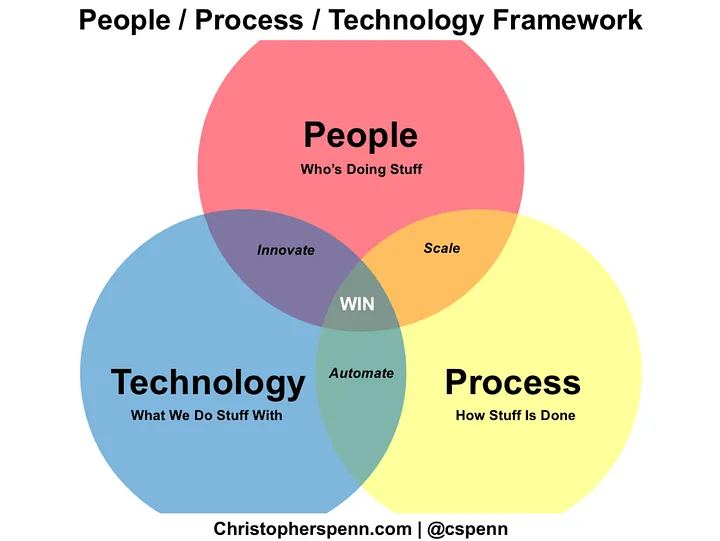
People, Process, Technology is a strategic model designed to enhance organizational performance and resilience. It highlights the critical interplay between the following three elements:
- People: The human capital driving innovation, decision-making, and value creation.
- Process: The systematic approaches that structure and streamline operations.
- Technology: The tools and systems that support and amplify human efforts and processes.
(Source)
This model asserts that the optimal alignment and integration of these three elements are essential for achieving efficiency, adaptability, and sustainable growth in any business environment.
People, Process, Technology Framework at a Glance
| Component | Description | Example |
|---|---|---|
| People | Employees, skills, and culture driving execution | Training teams, leadership, collaboration |
| Process | Structured workflows and systems | SOPs, workflows, automation |
| Technology | Tools that support people and processes | CRM, knowledge base, AI tools |
Why People, Process, Technology is Important
The People, Process, Technology framework is important because it ensures that all core parts of an organization work together instead of in isolation. When these elements are aligned, businesses can operate more efficiently, reduce errors, and make better decisions.
Without this alignment, organizations often face challenges such as inefficient workflows, low employee adoption, and underutilized technology. This leads to wasted resources and inconsistent performance across teams.
By integrating people, processes, and technology, organizations can:
- Improve operational efficiency and productivity
- Enhance collaboration across teams
- Reduce inefficiencies and bottlenecks
- Support better decision-making with accessible information
- Scale operations more effectively
A well-balanced approach allows businesses to adapt to change, implement new systems successfully, and maintain long-term growth without disruption.
The Core Elements of the PPT Framework
The People, Process, Technology framework is built on three core elements that must work together to improve efficiency, consistency, and scalability. Each element has a distinct role, but the real value comes from how well they are aligned.

(Source)
1. People
People are the foundation of the PPT framework, as they drive execution, decision-making, and innovation. Employees are responsible for creating, managing, and applying knowledge across the organization.
To maximize effectiveness, organizations must invest in training, communication, and a culture that encourages collaboration and knowledge sharing. When people are aligned with processes and supported by the right tools, adoption and performance improve significantly.
2. Process
Processes define how work is structured and executed. They provide clear workflows, reduce ambiguity, and ensure tasks are completed consistently.
Well-defined processes help eliminate inefficiencies, reduce errors, and make operations scalable. This includes standard operating procedures (SOPs), workflow automation, and continuous improvement practices to keep processes aligned with business needs.
3. Technology
Technology acts as an enabler that supports both people and processes. It provides the systems and tools needed to store, access, and share information efficiently.
The right technology improves speed, accuracy, and collaboration. However, it must be aligned with user needs and workflows, otherwise it can create friction instead of improving efficiency.
How People, Process, and Technology Work Together
The PPT framework is not about optimizing each element separately, but about ensuring they function as a unified system.
- People use processes to perform tasks
- Processes define how work flows across the organization
- Technology supports and enhances both people and processes
When one element is weak or misaligned, the entire system becomes inefficient.
How to Implement People, Process, Technology Framework
A structured approach ensures that improvements are sustainable and adopted across the organization.
Step 1: Assess Your Current State
Start by evaluating how people, processes, and technology currently function in your organization. Identify gaps such as inefficient workflows, low tool adoption, or a lack of collaboration between teams.
Step 2: Define Clear Objectives
Set specific goals for what you want to achieve, such as improving efficiency, reducing errors, or enhancing collaboration. Clear objectives ensure all three elements are aligned with business priorities.
Step 3: Optimize and Standardize Processes
Review existing workflows and eliminate unnecessary steps or bottlenecks. Standardize processes using clear documentation and SOPs to ensure consistency and scalability.
Step 4: Empower and Train Your People
Ensure employees have the skills, knowledge, and resources needed to follow processes and use technology effectively. Training and clear communication are critical for successful adoption.
Step 5: Implement the Right Technology
Choose tools that support your processes and improve how people work. Technology should simplify workflows, enhance collaboration, and integrate seamlessly with existing systems.
Step 6: Align and Integrate All Three Elements
Ensure people, processes, and technology work together as a unified system. Avoid optimizing one element in isolation, as misalignment can create inefficiencies.
Step 7: Monitor Performance and Gather Feedback
Track key metrics such as productivity, process efficiency, and tool usage. Use feedback from employees to identify gaps and areas for improvement.
Step 8: Continuously Improve and Scale
Regularly refine your approach based on data and changing business needs. Continuous improvement ensures your PPT framework remains effective as your organization grows.
People, Process, Technology Examples
Example 1: Customer Support Optimization
- People: Trained support agents
- Process: Standardized response workflows
- Technology: Help desk or knowledge base software
Result: Faster response times and improved customer satisfaction.
Example 2: Employee Onboarding
- People: HR and managers guiding new hires
- Process: Structured onboarding program
- Technology: Learning management system
Result: Faster onboarding and better employee experience.
Example 3: Sales Process Improvement
- People: Sales team
- Process: Defined sales funnel
- Technology: CRM system
Result: Improved conversion rates and better tracking.
People vs Process vs Technology
| Element | Focus | Role |
|---|---|---|
| People | Skills & collaboration | Execute and innovate |
| Process | Workflows & systems | Ensure consistency |
| Technology | Tools & automation | Enable efficiency |
People, Process, Technology Framework Use Cases
The following use cases exemplify how integrating people, processes, and technology can lead to significant improvements in organizational performance, fostering innovation and ensuring sustainable growth. Each scenario provides insights into how adjustments in one or more elements of the PPT triad can positively impact the overall outcome, illustrating the framework's practical applications in real-world business contexts.
USE CASE #1: Inefficient Customer Service Responses
- People: Assess the skill level and training of your customer service team. Are they adequately trained in customer engagement and equipped to handle queries effectively? Understanding their strengths and weaknesses is key.
- Process: Review the current customer service processes. Are there unnecessary steps or bottlenecks causing delays? Streamlining these processes can significantly improve response times.
- Technology: Implement or upgrade to a customer relationship management (CRM) system that can automate and organize customer queries, making it easier for your team to respond quickly and efficiently.
USE CASE #2: Low Productivity in Remote Work Settings
- People: Gauge the comfort and adaptability of your team to remote work. Are they facing challenges in communication, collaboration, or time management?
- Process: Establish clear remote work policies and procedures. This might include regular check-ins, clear deliverables, and effective communication protocols.
- Technology: Provide technology tools like collaborative software, project management tools, and secure VPN access to facilitate smooth remote operations.
USE CASE #3: High Turnover Rate in a Department
- People: Investigate the reasons behind the high turnover. Conduct exit interviews and employee surveys to understand the factors contributing to dissatisfaction.
- Process: Examine the HR processes for recruitment, onboarding, and employee engagement. Identify areas where improvements can be made to enhance employee retention.
- Technology: Utilize HR analytics tools to analyze patterns and trends in employee turnover. Leverage this data to make informed decisions about changes in HR processes and policies.
USE CASE #4: Difficulty in Managing Inventory Levels
- People: Train staff on effective inventory management practices. Ensure they understand the importance of accurate inventory tracking and its impact on business operations.
- Process: Review and optimize inventory management processes. Consider adopting just-in-time inventory practices to reduce excess stock and associated costs.
- Technology: Implement an inventory management system that can automate stock monitoring, provide real-time data, and predict inventory needs based on historical trends.
Elevate Organizational Capabilities Through Knowledge Management
Knowledge management (KM) goes hand-in-hand with the principles behind the people, process, and technology framework.
At the core of KM are the people, aligning with the PPT framework's focus. Knowledge predominantly resides within the minds of employees and is shared through collaboration and communication. Cultivating a culture where knowledge sharing is encouraged and rewarded is essential. Such an environment not only boosts individual learning but also amplifies the collective intelligence of the organization.
The processes in KM revolve around how knowledge flows within an organization, encompassing the development and implementation of systems for knowledge capture, storage, retrieval, and dissemination. Effective KM processes ensure timely and accurate information delivery, enhancing decision-making and overall operational efficiency. It’s about creating a seamless knowledge ecosystem that supports continuous learning and adaptation.
The third piece, technology, plays a facilitating role in capturing, storing, and sharing knowledge. Knowledge management software, ranging from intranets and knowledge bases to AI-driven analytics and collaborative platforms, can significantly elevate KM initiatives. They enable the maintenance of extensive knowledge repositories and ensure easy access to information for employees, irrespective of their location.
Using Helpjuice for Knowledge Management
Implementing the People, Process, Technology framework becomes much easier with the right tools in place. Helpjuice provides a centralized knowledge base platform that helps organizations capture, organize, and share knowledge efficiently.
With Helpjuice, teams can create structured knowledge bases that support clear processes, enable fast and accurate search, and improve collaboration across departments. This ensures that employees have instant access to the information they need, reducing inefficiencies and improving overall productivity.
The platform also supports analytics and reporting, allowing organizations to track how knowledge is used and identify gaps. By aligning people, processes, and technology in one system, Helpjuice helps businesses build a scalable and effective knowledge management strategy.
Sign up today for a free 14-day trial and discover how our comprehensive knowledge base solution can make a difference in your business.
Final Thoughts
The People, Process, Technology framework provides a practical approach to improving how organizations operate. When these three elements are aligned, businesses can reduce inefficiencies, improve collaboration, and scale more effectively.
The key is to treat people, processes, and technology as a unified system rather than separate components. Focusing on balance and continuous improvement ensures long-term success and adaptability in a changing business environment.
By implementing the PPT framework with the right strategy and tools, organizations can turn knowledge into a powerful asset that drives efficiency, innovation, and growth.