Key Takeaways
Open-source knowledge base software is a documentation platform whose source code is publicly available. Anyone can inspect it, modify it, and deploy it on their own infrastructure — typically at no licensing cost.
The main benefits are cost, control, and customization. Teams choose open source to avoid vendor lock-in, keep full ownership of their data, and retain the ability to modify the software to fit their workflows.
Open source and self-hosted are related but not the same thing. Open source refers to code availability. Self-hosted refers to where the software runs. An open-source tool can run on a managed cloud, and a self-hosted tool does not have to be open source.
The top open-source knowledge base tools in 2026 are BookStack, Outline, Wiki.js, DokuWiki, MediaWiki, XWiki, Docusaurus, and phpMyFAQ. Each serves a different use case, from internal team wikis to enterprise deployments to customer-facing documentation.
Introduction
In this guide, we’re going to tell you about open-source knowledge base software. We’ll tell you what this software is, why you should use it, and then we will tell you about the best choices that you can pick from in 2026.
Let’s get started. First, we’re going to bring you up to speed on what these knowledge base software are.
What Is Open-Source Knowledge Base Software?
A knowledge base is a centralized repository where information is organized, searchable, and accessible to whoever needs it. Open-source knowledge base software is simply a knowledge base platform where the source code is publicly available. Anyone can inspect it, modify it, and deploy it on their own infrastructure.
Here is a simple definition:
Open-source knowledge base software is a documentation and knowledge management platform whose source code is freely available for use, modification, and distribution.
Here is what this means in practice:
You can host it on your own servers and keep full control over your data
You can modify the codebase to fit your specific workflows
You are not locked into a vendor's pricing or roadmap decisions
The software is typically free to use, though some tools offer paid hosted versions alongside the open-source release
Why Teams Use Open-Source Knowledge Base Software
The main reason is cost. Most open-source knowledge base tools are free to use. For small teams or budget-conscious organizations, that alone makes them worth considering.
But cost is rarely the only reason teams choose open source. Here is what else drives the decision:
Control over your data. With a self-hosted open-source tool, your data lives where you put it. There is no third party storing your documentation on infrastructure you do not control. This level of sovereignty is a critical requirement for teams working in highly regulated industries, such as fintech app development, where strict data security, privacy, and compliance standards must be maintained.
No vendor lock-in. Proprietary tools can change their pricing, discontinue features, or shut down entirely. With open source, the codebase is yours regardless of what happens to the company behind it.
Customization. If the software does not do something you need, you can build it. Most open-source knowledge base tools have plugin ecosystems or accessible codebases that make modification realistic.
Transparency. The code is public. Security researchers, developers, and your own team can audit it.
Community support. Popular open-source projects tend to have active forums, GitHub discussions, and third-party documentation that can be more useful than a corporate support ticket.
The tradeoff is real, though. Open-source software requires someone on your team to handle installation, updates, and maintenance. If that capacity does not exist, the cost savings can disappear quickly.
What to Look for in Open-Source Knowledge Base Software
Audience fit: Some tools are optimized for internal teams, others for customer-facing documentation. Picking one that does not match your audience creates structural problems that are hard to work around later.
Editor experience: WYSIWYG editors work better for mixed or non-technical teams. Markdown-based editors suit developer-heavy teams who prefer a docs-as-code workflow.
Search quality: A knowledge base is only useful if people can find things in it. Look for full-text search at a minimum, and semantic or AI-powered search if your content library is large.
Permissions and access control: Consider whether you need guest access, role-based permissions, or SSO integration. Requirements vary significantly between internal and customer-facing use cases.
Authentication options: Teams with existing identity infrastructure will need LDAP, SAML, or OpenID Connect support. Not all tools offer this on the free tier.
Maintenance overhead: Some tools install in minutes and require minimal upkeep. Others demand a more hands-on approach. Match the tool to the technical capacity your team actually has.
AI features: Native AI support is still rare in open source. Know whether you need it built in or whether a plugin or external integration is acceptable.
Hosting flexibility: Check whether the tool can be fully self-hosted, cloud-hosted, or both. This matters if data residency or infrastructure control is a requirement for your organization.
The Best Open-Source Knowledge Base Software in 2026
Now, let’s discuss the best open-source knowledge base software that you can choose from, based on your exact needs and requirements.
Here is a table that offers a quick comparison of the different tools. You can use this for a quick overview before jumping into each tool’s details.
Tool |
License |
Best For |
Editor |
Self-Hostable |
AI Features |
BookStack |
MIT |
Internal teams |
WYSIWYG + Markdown |
Yes |
None |
Outline |
BSL 1.1 |
Modern team wiki |
WYSIWYG |
Yes |
Native (MCP) |
Wiki.js |
AGPLv3 |
Developer wikis |
WYSIWYG + Markdown + HTML |
Yes |
None |
DokuWiki |
GPLv2 |
Small teams, homelabs |
Markdown |
Yes |
Plugin only |
MediaWiki |
GPLv2 |
Large public wikis |
WikiText |
Yes |
Plugin only |
XWiki |
LGPLv2 |
Enterprise, Java orgs |
WYSIWYG + Wiki syntax |
Yes |
Plugin only |
Docusaurus |
MIT |
External dev docs |
Markdown / MDX |
Yes |
None |
phpMyFAQ |
MPL 2.0 |
FAQ management |
WYSIWYG |
Yes |
None |
1. BookStack
Best for: Internal teams that want structured, organized documentation without a steep learning curve.
 (Source)
About BookStack
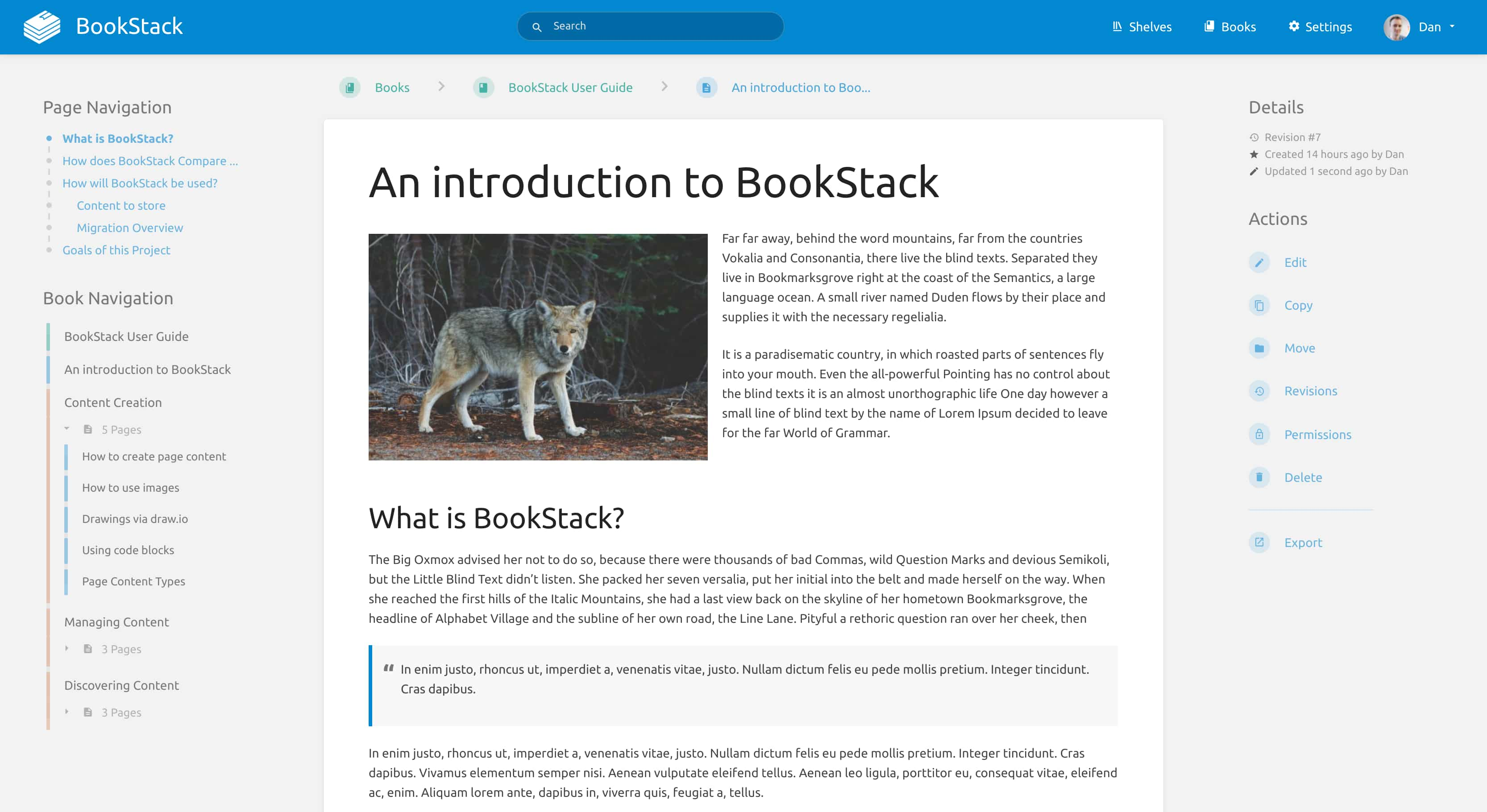
BookStack organizes content into a hierarchy of Shelves, Books, Chapters, and Pages. That structure sounds rigid on paper, but in practice, it keeps documentation tidy in a way that freeform wikis often fail to maintain over time. It runs on PHP and MySQL, which means it drops into standard server infrastructure without much friction. The interface is clean and modern, and the WYSIWYG editor is accessible enough for non-technical contributors.
Features of BookStack
WYSIWYG editor with Markdown support as an alternative
Role-based permissions and user management
LDAP, SAML 2.0, and OpenID Connect authentication
Full-text search across all content
Active development with regular security patches
Limited flexibility in content hierarchy. You cannot nest beyond the Books/Chapters/Pages structure
Visual customization options are relatively limited out of the box
2. Outline
Best for: Teams looking for a modern, Notion-like experience without vendor lock-in.

(Source)
About Outline
Outline is one of the better-looking open-source knowledge base tools available right now. It supports real-time collaboration, has a fast and intuitive editor, and feels closer to a modern SaaS product than most open-source alternatives.
It is worth noting that Outline uses a BSL 1.1 license rather than a traditional open-source license, which restricts certain commercial use cases. Read the license terms before deploying it in a commercial context.
Features of Outline
Real-time collaborative editing
Strong permissions model with user groups and guest access
Slack integration and an open API
Self-hostable with Docker
Built-in MCP server for AI assistant integration, added in early 2026
BSL 1.1 license is not a true open-source license by OSI definition
Requires more infrastructure setup than simpler PHP-based tools
Authentication setup is mandatory and can trip up first-time self-hoster
3. Wiki.js

(Source)
Best for: Developer teams that want a feature-rich wiki with Git-backed storage and broad authentication options.
About Wiki.js
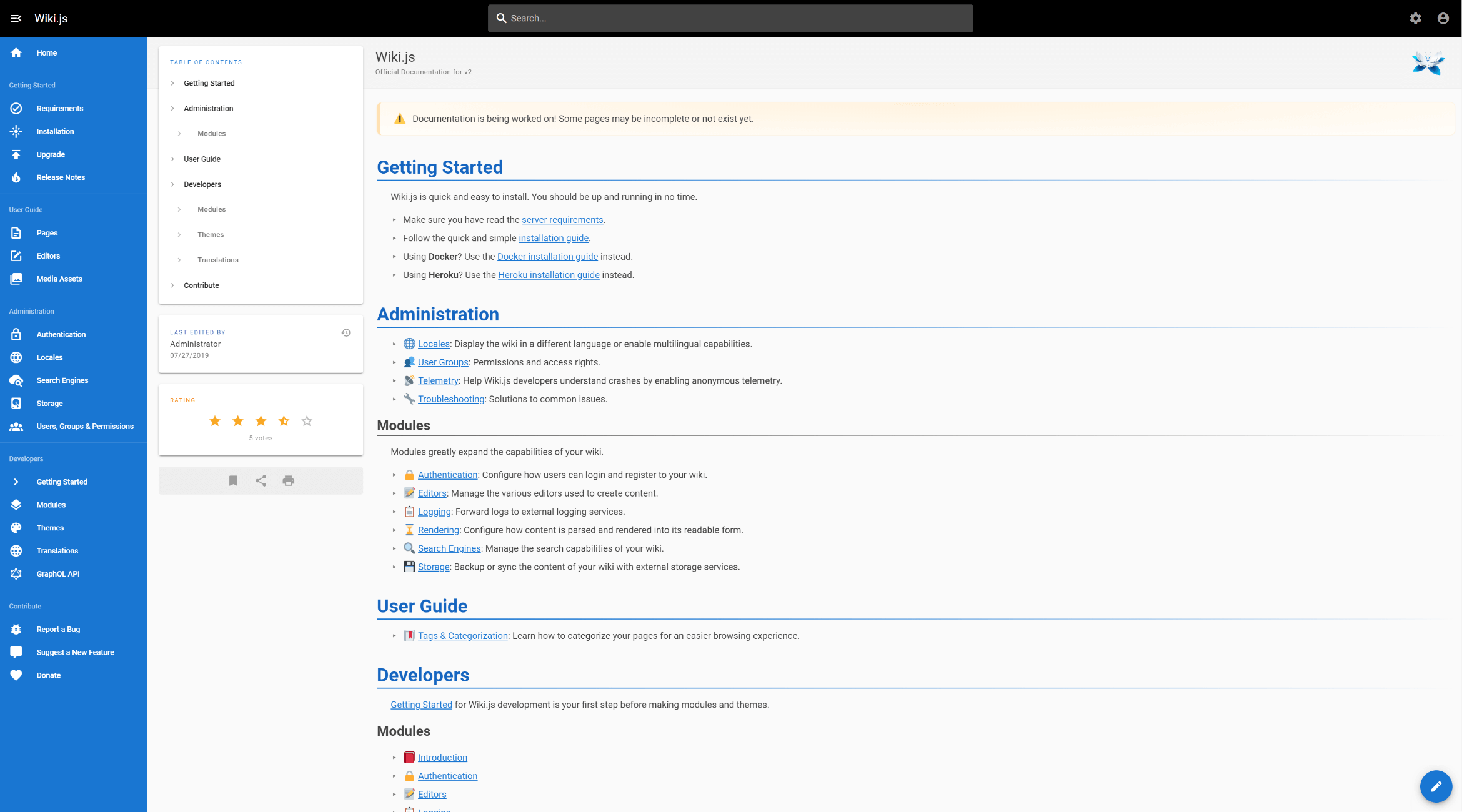
Wiki.js is a capable, modern wiki built on Node.js with a clean interface and an impressive feature set for a free tool. It supports multiple editors, Git-based storage, and over 50 integrations. The caveat worth knowing upfront: version 3.0 has been in development since 2022 and remains unreleased in stable form, with progress slowing due to the lead developer's health issues. Version 2 is stable and production-ready, but the long-term trajectory of the project is uncertain enough that it warrants caution before making a long-term commitment.
Features of Wiki.js
Multiple editor options, including Markdown, WYSIWYG, and HTML
Git-backed storage for version control
Broad authentication support, including LDAP, SAML, Google, and GitHub
Supports PostgreSQL, MySQL, MariaDB, and SQLite
Active community and solid documentation
Limitations of Wiki.js
Version 3.0 development has stalled with no confirmed release timeline
Heavier infrastructure requirements than PHP-based alternatives
4. DokuWiki
Best for: Small teams or homelabbers who want something reliable, lightweight, and easy to maintain.

What is DocuWiki?
DokuWiki has been around since 2004. It requires no database as the content is stored as plain text files, which makes backups trivially simple and hosting requirements minimal.
The plugin ecosystem is extensive enough to cover most common needs. The interface looks dated compared to newer tools on this list, but for teams that prioritize function and stability over aesthetics, that is a reasonable tradeoff.
Features of DocuWiki
No database required — plain text file storage
Large plugin ecosystem covering search, authentication, and formatting
Low server resource requirements
Strong access control features
Simple installation and minimal maintenance overhead
Limitations of DocuWiki
Interface is noticeably dated compared to modern alternatives
Not well-suited for large-scale or enterprise deployments
Limited real-time collaboration features
5. MediaWiki
Best for: Large-scale, community-driven, or public-facing wikis that need proven scalability.

What is MediaWiki?
MediaWiki is the engine that runs Wikipedia. That context is useful because it tells you both what it is good at and what it is not. It handles enormous content volumes and large contributor bases without breaking a sweat.
What it does not do well out of the box is function as a modern team knowledge base. The default interface is utilitarian and getting it to behave like a clean internal wiki requires plugins and configuration work. For most internal team use cases, there are better options on this list.
Features of MediaWiki
Proven at extreme scale
Extensive plugin library via MediaWiki extensions
Strong revision history and content auditing
Large support community and deep documentation
Limitations of MediaWiki
Not optimized for internal team use without significant configuration
Steeper learning curve than most tools here
Default interface requires work to modernize
6. XWiki
Best for: Large organizations with complex customization requirements and existing Java infrastructure.

What is xWiki?
XWiki is the most extensible tool on this list. It is Java-based, which means it integrates naturally into organizations already running Java application servers. The extension marketplace is deep, and the platform can be shaped into almost anything given enough development time.
That power comes with a cost: XWiki has a steeper learning curve than anything else here, and it is not the right choice for teams that want to be up and running quickly.
Features of xWiki
Highly extensible via a large extension marketplace
Enterprise authentication, including LDAP, SAML, and OpenID Connect
Structured data and macro support for advanced content modeling
Strong audit and compliance features
Active development and commercial support options available
Limitations of xWiki
Steeper learning curve than most tools on this list
Java infrastructure requirements add complexity for non-Java environments
Can feel heavy for smaller teams with straightforward needs
7. Docusaurus
Best for: Developer teams building external or public-facing documentation sites.

What is Docusaurus?
Docusaurus is not a wiki, and it is not an internal knowledge base. It is a static site generator built for documentation, maintained by Meta, and widely used across the open-source world for developer portals and project docs.
Content lives in a Git repository as Markdown or MDX files, which fit naturally into developer workflows. It produces fast, well-structured documentation sites with versioning and Algolia-powered search built in. If your use case is internal team documentation, look elsewhere on this list.
Features of Docusaurus
Markdown and MDX support with React component embedding
Built-in versioning for maintaining multiple doc sets
Algolia-powered search out of the box
Fast static output with strong SEO characteristics
Maintained by Meta with an active contributor community
Limitations of Docusaurus
Not suited for internal wikis or collaborative editing in a browser
Requires developer involvement to set up and maintain
Content editing happens in code, not in a browser interface
8. phpMyFAQ
Best for: Teams whose primary need is a structured, searchable FAQ rather than a full knowledge base.

What is phpMyFAQ?
phpMyFAQ is a specialist tool that does one thing well: FAQ management. It is PHP-based, straightforward to install, and comes with solid search, multi-language support, and a clean user interface. It is worth being clear about the scope here — phpMyFAQ is not a general-purpose knowledge base or wiki. If you need article management, nested documentation, or collaborative editing, it will feel limiting quickly. But for teams that specifically need a well-organized, searchable FAQ, it covers the requirement cleanly.
Features of phpMyFAQ
PHP-based with straightforward installation
Multi-language support
Built-in search with relevance ranking
User roles and access control
Active development and regular releases
Limitations of phpMyFAQ
Narrow scope; built specifically for FAQs, not broader knowledge management
Limited content structuring options beyond FAQ categories
Not suited for teams that need full documentation or wiki solution
Open Source vs. Commercial Knowledge Base Software
Open source is not automatically the right choice, and commercial software is not automatically the wrong one. The decision comes down to what your team actually has: time, technical capacity, and budget. Regular knowledge base software have their own perks, which can be hard to come by in an open-source one.
What you gain with open source
No licensing costs in most cases
Full control over your data and where it lives
The ability to modify the software to fit your workflows
No dependency on a vendor's roadmap or pricing decisions
What you trade off
Someone on your team owns installation, upgrades, and maintenance
Support comes from community forums rather than a dedicated team
Onboarding new contributors takes longer without polished documentation and UI
Security patches require your attention rather than happening automatically
Frequently Asked Questions (FAQs)
What is open-source knowledge base software?
Open-source knowledge base software is a platform for organizing and sharing information where the source code is publicly available.
Anyone can inspect, modify, and deploy it. Most open-source knowledge base tools are free to use, though some offer paid hosted versions alongside the open-source release.
Is open source the same as self-hosted?
No. Open source refers to the license and code availability. Self-hosted refers to where the software runs.
An open-source tool can be hosted on a managed cloud service, and a self-hosted tool does not have to be open source. The two often go together in practice, but they are separate concepts.
Which tools on this list are completely free with no paid tier required?
BookStack, DokuWiki, MediaWiki, and phpMyFAQ are fully free with no paid tier.
Outline and Wiki.js are free to self-host but offer paid cloud-hosted versions. Docusaurus is free but requires your own hosting. XWiki has a free community edition alongside commercial offerings.
Which open-source knowledge base is easiest to set up?
DokuWiki and BookStack are generally the easiest to get running.
DokuWiki requires no database and installs with minimal configuration. BookStack runs on a standard PHP and MySQL stack with straightforward setup documentation.
Can any of these be used for customer-facing documentation?
Yes. Docusaurus is particularly well-suited for public-facing documentation sites.
BookStack and Wiki.js can also serve customer-facing use cases with the right permissions configuration. phpMyFAQ works well specifically for customer-facing FAQ pages.