
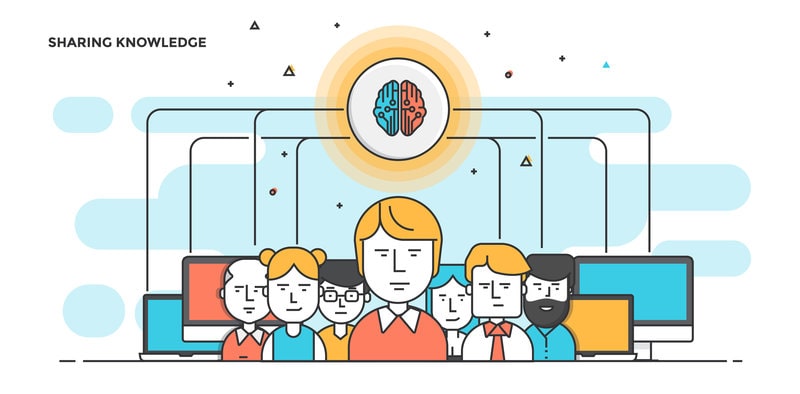
Knowledge sharing is an important process that can improve the efficiency of an organization and its members.
The collective knowledge held by employees is one of the most valuable assets a company possesses. It enables employees to perform their roles effectively, supports smoother business operations, and helps organizations maintain a competitive advantage.
Research also highlights its importance. According to Deloitte's Human Capital Trends report, 75% of organizations surveyed believe that creating and preserving knowledge is essential to their success.
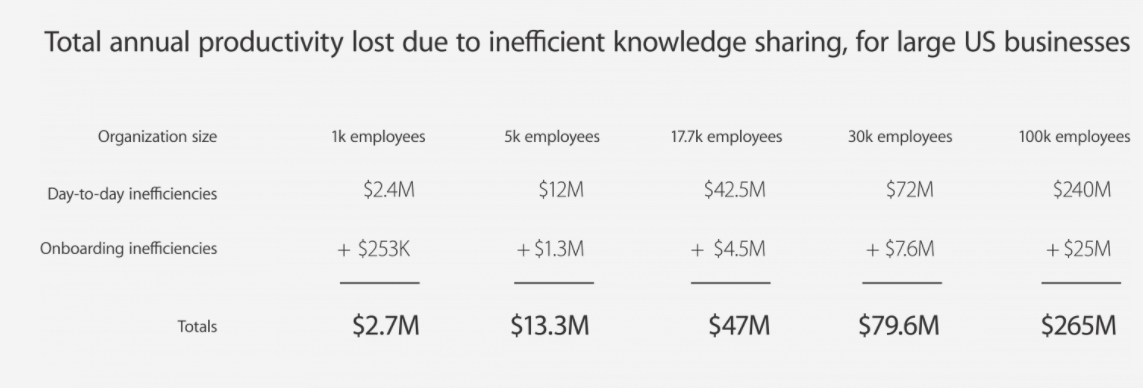
Apart from efficiency, knowledge sharing can also help organizations save money. In fact, inefficient knowledge sharing can cost US businesses anywhere from $2.7 million to $265 million in productivity, depending on company size. With proper knowledge sharing, on the other hand, all of this amount can be saved.
 (Source)
What is Knowledge Sharing?
Knowledge sharing is the process of exchanging information, ideas, experiences, and expertise among individuals or groups. Within organizations, knowledge sharing enables employees to learn from one another and apply collective knowledge to solve problems and improve performance.
It is a fundamental part of knowledge management, helping organizations capture valuable knowledge and make it accessible to the people who need it.
Knowledge can exist in different forms, and understanding these forms helps organizations design better knowledge-sharing systems.
Types of Knowledge
Tacit knowledge is often shared through direct interaction, observation, and mentorship. Explicit knowledge is easier to distribute because it can be documented and stored. Implicit knowledge develops through shared organizational experience.
Understanding these different knowledge types helps organizations capture, preserve, and distribute valuable information more effectively.
Before exploring strategies to improve knowledge sharing, it is important to understand why it matters for organizational success.
How to Encourage Knowledge Sharing in the Workplace
Encouraging knowledge sharing requires both the right organizational culture and the right systems that make sharing information easy. When employees have the tools, processes, and motivation to exchange knowledge, organizations can improve collaboration, reduce duplicated work, and preserve valuable expertise.
Below are several proven strategies organizations can use to encourage knowledge sharing in the workplace.
1. Build a Culture That Promotes Knowledge Sharing
A strong knowledge-sharing culture encourages employees to exchange ideas, expertise, and experiences regularly. When organizations actively support collaboration and learning, knowledge sharing becomes a natural part of everyday work.
However, many companies struggle in this area. Studies show that nearly a third of organizations rate their knowledge-sharing culture at 5 or lower on a 10-point scale, which highlights the difficulty many teams face in encouraging open collaboration.

(Source)
Creating a culture that promotes knowledge sharing begins with establishing a clear mission, shared goals, and a growth mindset throughout the organization. Employees should feel comfortable sharing insights, asking questions, and collaborating across teams.
Organizations can also encourage knowledge exchange by creating communities of practice or communities of excellence, where employees gather to share expertise, best practices, and lessons learned.
When knowledge sharing becomes embedded in company culture, employees naturally contribute what they know and continuously learn from one another.
2. Make it Easy to Share and Preserve Knowledge
Even when employees are willing to share information, knowledge sharing will not happen consistently unless organizations provide the right tools and channels.
Companies must create systems that allow employees to share knowledge easily and store it for future use. This can include collaboration platforms, documentation tools, internal communication channels, and scheduled knowledge-sharing sessions.
Providing multiple ways to share knowledge is especially important in modern workplaces where remote work is increasingly common. Employees need both real-time communication opportunities and structured knowledge-sharing processes.
Organizations should also ensure that knowledge is preserved once it is shared. Capturing and storing valuable insights, often referred to as knowledge assets, helps companies retain expertise and ensure information remains accessible over time.
When knowledge sharing becomes both easy and structured, employees are far more likely to contribute their expertise.
3. Centralize Your Knowledge to Create a Single Source of Truth
One of the most effective ways to improve knowledge sharing is by centralizing organizational knowledge in a single source of truth (SSoT).
A single source of truth ensures that employees can access accurate, organized, and up-to-date information whenever they need it. This approach prevents outdated documentation, duplicated work, and confusion caused by scattered information.
Knowledge-sharing systems help support this process by storing both explicit and tacit knowledge in centralized repositories.
According to Sirje Virkus, faculty member at the Institute of Information Studies at Tallinn University:
“Knowledge Sharing Systems support the process through which explicit or tacit knowledge is communicated to other individuals. These systems are also referred to as knowledge repositories.”
Below is a simplified overview of the types of knowledge organizations typically manage.
Organizations often use knowledge management tools to create this centralized knowledge system. One of the most effective approaches is implementing knowledge base software to build an internal knowledge base.
Modern knowledge base platforms offer capabilities similar to corporate wikis but with additional functionality designed for structured knowledge management.
With a knowledge base, organizations can:
Control access permissions to sensitive knowledge content
Help employees find information quickly through powerful search features
Analyze knowledge usage through detailed analytics
An internal knowledge base can store valuable information such as training manuals, process documentation, standard operating procedures, and educational resources. It can also include video tutorials to capture tacit knowledge and demonstrate complex tasks.
By creating a centralized digital repository, organizations make it significantly easier for employees to access and share knowledge across teams.
4. Define Roles
Knowledge sharing becomes more effective when responsibilities are clearly defined. While every employee contributes to knowledge sharing, some initiatives require more structured roles.
For example, organizations may designate subject matter experts, mentors, or trainers to guide knowledge-sharing activities. These individuals can lead training sessions, document best practices, or support onboarding programs.
Defined roles are particularly useful for structured learning initiatives such as mentoring programs, internal workshops, and onboarding processes.
By clarifying responsibilities, organizations can ensure that knowledge sharing remains consistent and organized.
5. Standardization of Knowledge Sharing Workflows
Knowledge sharing should follow a structured process to ensure information is delivered consistently and effectively.
Without clear workflows, valuable insights may be lost or shared inconsistently across teams.
Organizations can improve knowledge sharing by establishing clear processes that define how knowledge is captured, documented, and distributed.
Key elements of a standardized knowledge-sharing workflow include:
Identifying what knowledge should be shared
Defining who participates in the sharing process
Establishing how knowledge is documented and communicated
Confirming that knowledge has been successfully transferred
Creating procedures for situations where knowledge transfer fails
These guidelines help ensure that knowledge sharing remains organized while still allowing flexibility for collaboration and innovation.
6. Encourage and Reward Effort
Providing employees with tools and processes for knowledge sharing is only part of the solution. Organizations must also encourage employees to actively participate.
Recognizing and rewarding knowledge-sharing efforts can motivate employees to contribute more frequently. When employees feel that their contributions are valued, they are more likely to share expertise and support colleagues.
Organizations can reinforce knowledge-sharing behavior through both intrinsic and extrinsic motivation.
Intrinsic motivation may include recognition, professional growth opportunities, or public acknowledgment of contributions. Extrinsic motivation can include tangible rewards such as bonuses, incentives, or performance recognition programs.
By creating an environment that celebrates knowledge sharing, organizations can strengthen collaboration and encourage continuous learning.
Best Practices for Sustaining Knowledge Sharing
On top of following the steps above, you should keep these best practices in mind to make the most of your efforts in encouraging knowledge sharing.
Capture knowledge early: Encourage employees to document lessons learned immediately after completing projects or solving problems so valuable insights are not forgotten.
Integrate sharing into routine work: Add brief knowledge-sharing moments to meetings, retrospectives, or project reviews so learning becomes part of everyday workflows.
Focus on clarity over perfection: Encourage teams to share useful information quickly without waiting for perfect formatting or extensive editing.
Use simple documentation templates: Provide structured formats for process guides, troubleshooting notes, and project summaries to make documentation faster and more consistent.
Promote cross-team visibility: Allow teams to access and explore knowledge created by other departments to expand learning across the organization.
Review and update content regularly: Schedule periodic checks to ensure documentation stays accurate as tools, processes, and policies evolve.
Improve searchability: Use clear titles, tags, and categories so employees can quickly locate relevant knowledge when they need it.
Lead by example: Encourage managers and experienced employees to actively share insights and document expertise to set the standard for the rest of the team.
Benefits of Encouraging Knowledge Sharing in the Workplace
The purpose of knowledge sharing is to increase the collective knowledge of an organization. When employees exchange information and expertise, teams can solve problems faster, make better decisions, and develop innovative solutions.
While creating a knowledge-sharing culture requires effort, the benefits can be significant.
1. Improves Organizational Alignment
Knowledge sharing helps employees stay aligned with company goals, mission, and priorities. When information flows freely across teams, employees remain informed and focused on shared objectives.
2. Increases Productivity

Employees spend nearly 20 percent of their work week searching for information needed to perform their jobs. When organizations make knowledge easily accessible, employees spend less time searching and more time completing meaningful work.
Improved knowledge sharing ensures that employees can quickly access the information they need, increasing efficiency and productivity.
3. Enhances Knowledge Retention
The retention of knowledge on an individual level is vital to the performance of that individual. However, when working in a team environment, everyone must have the same knowledge. A single mistake can lead to team-wide setbacks and reduced performance.
To ensure this does not happen, the entire team needs to retain pertinent information. By sharing knowledge and expertise, organizations can identify and capture valuable knowledge and store it in a structured and organized way. This can make it easier for team members to access and retain the knowledge they need to do their jobs effectively.
Additionally, when employees are encouraged to share their knowledge and expertise with others, it creates a cycle where the employees are encouraged to apply the knowledge they have acquired in their work, which can help to reinforce their understanding and retention of the material that's been shared.
4. Improves Communication and Collaboration
Knowledge sharing encourages collaboration across departments and teams. When employees exchange ideas and expertise, organizations can break down silos and create stronger working relationships.
This collaboration can also extend to external partners, customers, and stakeholders.
5. Reduces Operational Costs
Sharing knowledge prevents duplicate work and reduces the time employees spend solving problems that others have already addressed. For example, when Intel investigated product issues, they discovered that 60% of the problems had already been solved by another team.
6. Increases Employee Satisfaction and Retention
When employees have access to knowledge and feel empowered to contribute their expertise, they often feel more confident and engaged in their work. This autonomy can increase job satisfaction and reduce employee turnover.
Furthermore, knowledge sharing can help to create a culture of continuous learning and improvement, which can help with improving employee motivation and therefore employee retention.
7. Encourages Innovation
Knowledge sharing encourages the exchange of ideas and perspectives, which can stimulate innovation and creativity. By fostering a culture of continuous learning and improvement, organizations can encourage employees to think creatively and come up with new ideas and solutions, enabling organizations to sustain a competitive edge.
Barriers to Knowledge Sharing
Even though knowledge sharing can significantly improve collaboration and productivity, many organizations struggle to implement it effectively. Cultural, organizational, and communication challenges often prevent employees from sharing information openly.
Understanding these barriers is the first step toward building a knowledge-sharing environment. When organizations identify the obstacles that limit knowledge exchange, they can create strategies that encourage employees to collaborate and share expertise more effectively.
Below are some of the most common barriers that can prevent knowledge sharing in the workplace.
1. Knowledge Silos
Knowledge silos occur when information is isolated within specific teams, departments, or individuals instead of being shared across the organization. When departments operate independently and rarely communicate with one another, valuable insights and experience remain confined to small groups.
This lack of information flow can reduce collaboration and make it harder for teams to work toward shared goals. Employees may unknowingly duplicate work or struggle to solve problems that other teams have already addressed.
Knowledge silos often form unintentionally. Departments naturally focus on their own objectives and responsibilities, which can limit cross-team communication. Over time, this separation creates barriers that prevent knowledge from spreading throughout the organization.
Organizations must take deliberate steps to encourage collaboration across teams and ensure information moves freely between departments.
2. Knowledge Hoarding
Knowledge hoarding occurs when employees intentionally withhold information instead of sharing it with colleagues. This behavior can slow down problem-solving and limit collaboration within teams.
Although it may seem uncommon, knowledge hoarding can occur in many workplaces. Employees may keep information to themselves for several reasons, including competition with colleagues, fear of criticism, or a desire to maintain job security.
For example, an employee may believe that withholding knowledge gives them a competitive advantage or makes them appear more valuable to the organization. Others may hesitate to share ideas if they worry their contributions could be criticized.
Addressing knowledge hoarding requires building a workplace culture that encourages openness, trust, and collaboration. When employees feel safe sharing ideas and expertise, they are more likely to contribute knowledge that benefits the entire organization.
3. Lack of Opportunity
In many organizations, employees are willing to share knowledge but simply lack the opportunity to do so. This challenge has become more common as remote and distributed work environments grow.
In traditional office settings, knowledge sharing often happens naturally during everyday interactions. Conversations in meetings, shared workspaces, and informal discussions allow employees to exchange ideas and learn from one another.
Remote work environments can limit these spontaneous interactions. When employees communicate primarily through scheduled meetings or digital channels, opportunities for informal knowledge exchange may decrease.
To overcome this barrier, organizations should create intentional opportunities for employees to share knowledge. Regular team discussions, collaborative platforms, and internal documentation systems can help facilitate communication and ensure knowledge remains accessible to everyone.
Types of Knowledge Sharing That Occurs in the Workplace
Knowledge sharing can take many forms depending on how employees interact and collaborate.
1. Formal Training Programs
Structured training programs allow organizations to teach employees specific skills and knowledge through workshops, courses, or internal training sessions.
2. Mentorship
Mentorship enables experienced employees to guide newer team members by sharing insights, advice, and expertise.
3. Collaboration
Teams often share knowledge through collaborative projects, meetings, and discussions where employees contribute ideas to achieve shared goals.
4. Knowledge Management Software
Organizations often use tools such as collaboration platforms, intranets, and knowledge base software to facilitate knowledge sharing.
5. Informal Knowledge Sharing
Informal exchanges occur naturally during conversations, team interactions, or social settings where employees share experiences and insights.
Wrapping Up
Successful knowledge sharing depends on both people and technology. Organizations must create an environment where employees feel encouraged to exchange ideas and provide tools that make knowledge accessible.
Technology such as knowledge bases can significantly improve how information is captured, stored, and distributed.
By creating a comprehensive knowledge base with Helpjuice, organizations can centralize documentation, streamline knowledge sharing, and ensure valuable information remains accessible to everyone who needs it.




.png)
